The Anabaptist Kingdom of Münster deserves more than a footnote in history books:
It is a very early and well-documented example of the complete failure of socialist planned economy.
Economic Roots of the Takeover
The takeover by the "Anabaptists" was superficially religiously motivated, but ultimately had economic roots: Before, Münster (unusual for a city of that time) was quasi-feudally ruled by "Erbmänner" who formed the city council. They came from traditionally Catholic patrician families. Starting from craftsmen, a seemingly religious reformist movement developed, which finally gained power over Münster in February 1534.
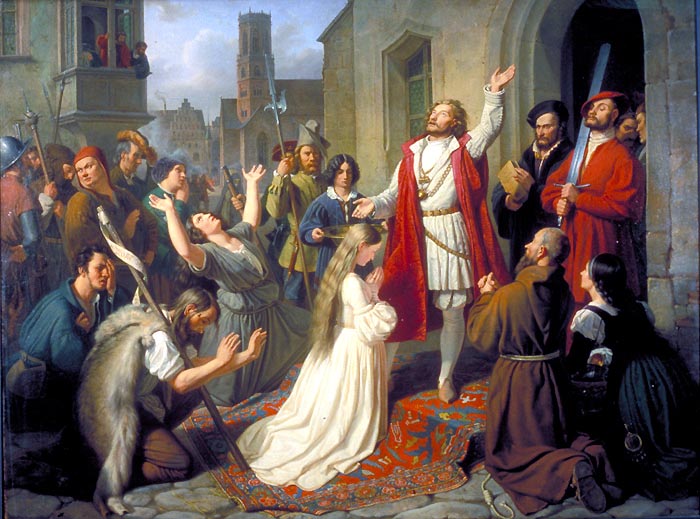
Immediate Measures After the Takeover
They immediately do what commies (without that word existing back then) just do:
"Cultural Revolution": In an iconoclastic rampage, almost all old art is immediately and irretrievably destroyed.
Central Registration: Immediately, all food supplies, precious metals, and clothing are centrally inventoried and recorded in lists by "deacons."
The Abolition of Money
Towards early summer, money is banned and all precious metals and jewelry are confiscated. There are central allocations of goods, but no complete expropriation yet and still barter trade. Rationing seems to become much harsher by autumn. By spring 1535 at the latest, there seems to be virtually no private property left.
Paradoxically, the previously confiscated precious metals are used to mint new coins, even though money is banned in the city - the rulers are trying to get weapons and mercenaries from outside to prevent the city from being recaptured.
The End
In summer 1535, the city's supply collapses completely and the Prince-Bishop of Waldeck is finally able to capture the city in June and end the speedrun experiment in early communism.

It supposedly took over 60 years for Münster to even regain its old population.