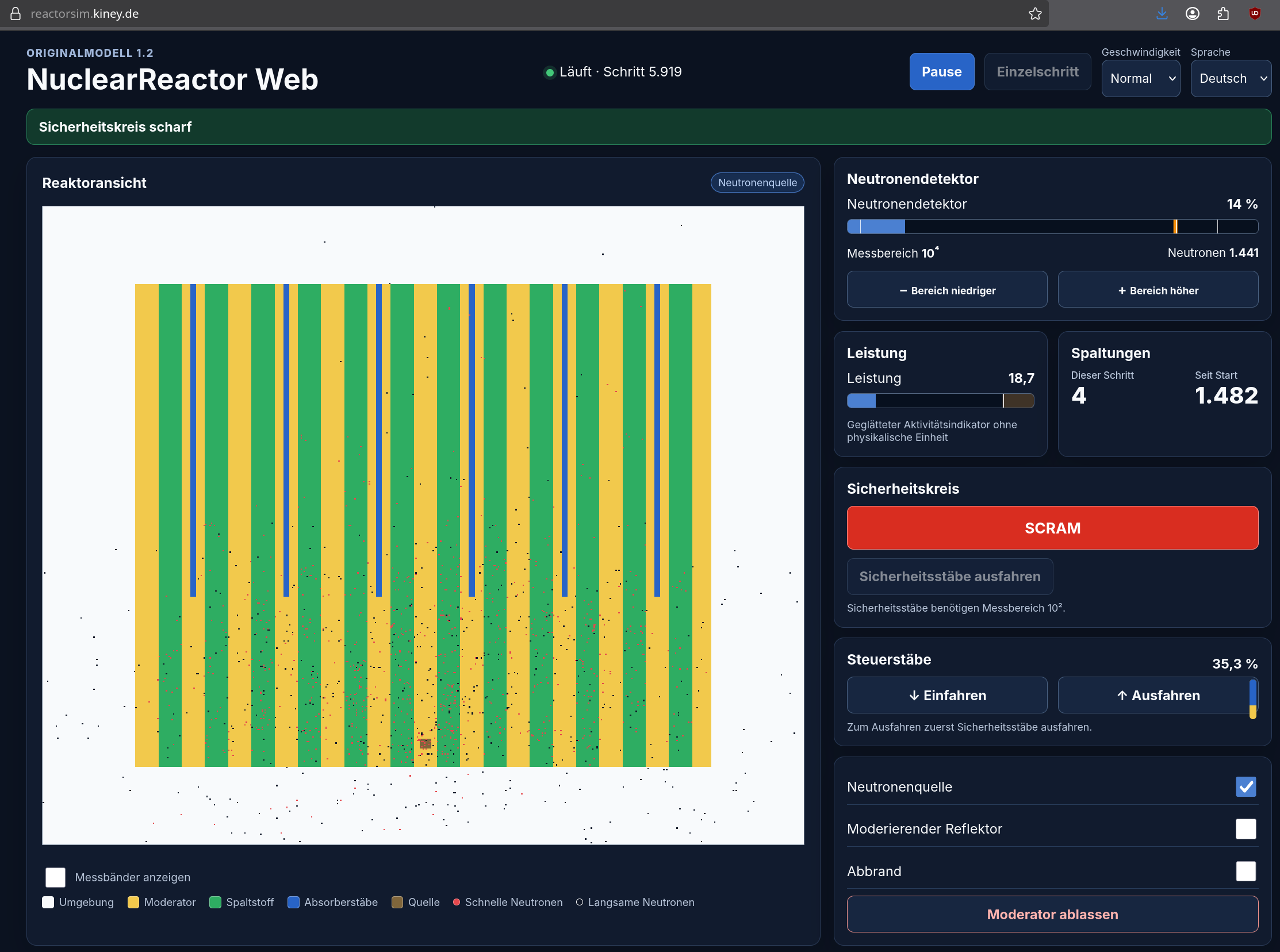
tl;dr: I used Codex to build a new version of an old educational nuclear reactor simulator. Available here: reactorsim.kiney.de
Why?
When I was at school in the early 2000s – when there was still hope that Germany's nuclear phase-out might be reversed – I had “something involving nuclear technology” on my shortlist of possible fields of study.
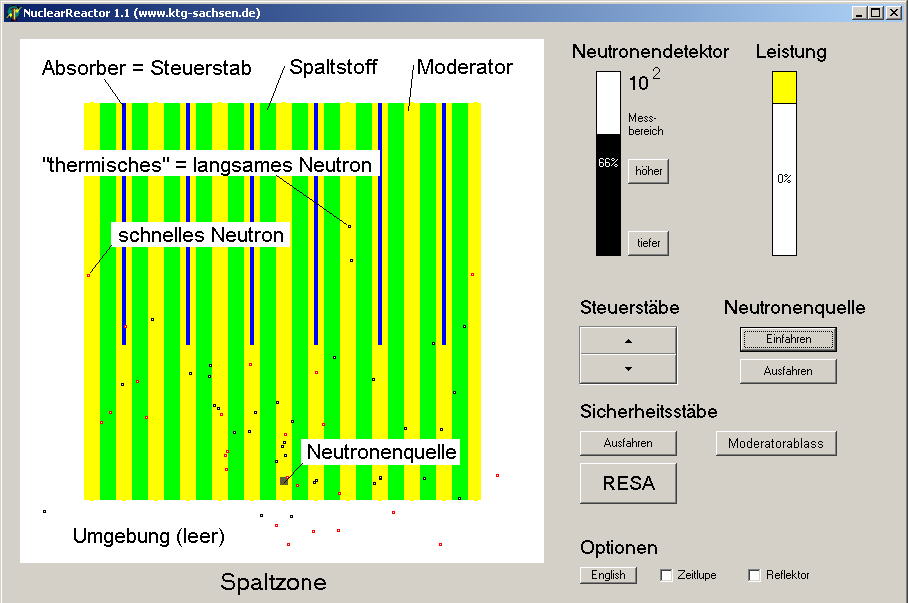
At the time, I read a lot about nuclear energy and devoured all the resources then available online, alongside the publications of the “Informationskreis Kernenergie”. These included a series of educational, highly simplified 2D Monte Carlo simulators by Prof. H.-M. Prasser. While browsing through my files recently, I stumbled across them again.
Unfortunately, these simulators are old standalone Windows applications that were apparently developed in Delphi. Running them on a modern system with Wine does work, but I think these tools still have educational value today and should be more accessible.
I used Codex to build a new version of the “main version” (the other variants model special research reactors). Since I ultimately studied computer science rather than nuclear technology, I tried to keep the technical simulation core slavishly close to the original, but completely reinterpreted the UI as a modern web application. However, the architecture already allows the simulation core to be replaced at a later stage.
How?
It is a complete clean-room implementation:
- I asked Codex to thoroughly analyze the old
.exeand create Markdown documentation focused on the algorithmic details. This took a few “rounds” with individual follow-up questions and short manual live tests of the application using Wine. The model used was GPT-5.6 Sol with Medium Reasoning. - I interactively created an architecture document in Markdown with Codex and GPT-5.6 Sol with XHigh Reasoning.
- I asked Codex, using
/goaland Medium Reasoning again, to implement the application in one shot according to the new architecture specifications and the documented algorithms. 2 hours and 11 minutes later, the application was ~done. Only tiny improvements to deployment and, above all, the README were needed.
All of this was also intended as a test of the capabilities of Codex + GPT-5.6 Sol. Overall, the harness-model combination performs very convincingly for this use case. In particular, the actual reimplementation was almost hands-off.